Previous Capers

Showing posts with label Purple Sprouting Broccoli. Show all posts

Thursday, June 6, 2013

Reviewing the Seasonality of Vegetables: Consider Lifestyle

Now that I've been cultivating veg going into the 4th year, I've been determined to better fine tune when I plant certain crops. Not that couldn't plant these crops at other times, but I've decided that there are certain times that suite my life better. As much that seasonality is about crop cycles, it's also about lifestyle. And if the plant has a flexibility, it's good to grow it to best suite how you use it. Given the limited space here at Mog Cottage, in some instances I would rather use the space for more seasonally sensitive crops. Seasonality is also about when pests peak too.

Those telltale holes mean cabbage moths have been at it.
Take kale. Every year I plant kale in the spring only to fight with those pesky cabbage moths ((Mamestra brassicae)) putting up an elaborate hoop house with Reemay to hermetically seal off the kale from the world. All this to keep a leaf eating larvae off my kale leaves. This year may be particularly bad given the warm winter we had. I was given 3 broccoli starts this spring. Since I'm not eating the leaves, I just covered them long enough to produce enough leaves where moth damage won't be so disconcerting.

Last year, I didn't get kale planted until August. Actually, I have been known to let kale go to seed and it comes up on its own quite well, even in late fall! At this point, the moths were pretty much gone while the kale started to grow (draping a bit of Reemay over the bed long enough to establish the plants). Kale over-winters nicely here and I like to use kale mainly in the fall and winter months in soups and stews. It also takes up a lot of space. So, the kale can grow and hog the beds when other crops won't grow because it's too cold. It slows down when the weather gets frosty, but perks right back up when the temperature returns to the mid 40's. In mid-spring, it goes to seed, so it gets yanked. I have enough kale seed to last longer than the seed will be viable.

With that, my winter beds consist mainly of garlic, onions, fava beans and kale. Occasionally, I'll plant other cabbage crops such as Filderkraut and, yes, purple sprouting broccoli is on the list. I recently purchased a new packet of the Ed Hume PSB seeds that famously exploded and lasted three years until an infestation of aphids took it out.

So, for summer, I'm planting a great substitute for kale: Swiss chard. It's a great leafy green from the beet family and can be used in most any recipe as a substitute for kale. It takes up less space, leaving room for summer crops. In fact, Swiss chard has a higher nutrient density than kale containing copious amounts of Magnesium, Phosphorus, Potassium, Copper, Beta carotene, Isoleucine and Phenylalanie. Swiss chard is a biennial that pretty much over-winters too, but tends to look rather ragged with time, so I pull it out when it's time to plant the kale.

Although chard supposedly attracts moths too, I've experienced only one issue with Swiss Chard: mollusks. I end up mulching with Slug-go and spent coffee grounds as no amount of Reemay keeps those buggers out. Here, in the great Pacific North-wet, slugs and snail season is 12 months. In the gardening world, it's always something.


Saturday, March 31, 2012

It's Baaaaack!

Those darling little purple florets have just appeared.
On the way to the woodpile I passed by the raised beds and was astonished to see Purple Sprouting Broccoli florets! It's barely April and my PSB is putting forth vast amounts of edible purple yumminess. What's really surprising is the fact that it's producing those florets on close to 3 year old stalks.

Granted, this is a variety that takes around 8 months to start producing in the first place. However, I planted the seeds in late April of 2010 and the first summer I got nothing but a thicket of 6 foot tall stalks with 2 foot long leaves that took over the entire 8 ft. by 4 ft. bed. As it turns out, this is an heirloom variety that one should plant in the fall so 8 months later you can theoretically harvest something in late summer. After discovering my oops, I overwintered the bunch but only 3 stalks made to spring. PSB is supposed to be very frost hardy, but these 3 plants survived that early big freeze we had in the fall of 2010. The next spring, those plants exploded and I had so much PSB that a lot of it flowered and ended up in the compost pile because I couldn't keep up with it. I assumed that the mass production were the plants death throws to reproduce before they droop dead. How wrong I was! The plants overwintered a second time and this year, they're producing earlier than ever only this time, I'm determined to nip this in the bud before it all gets out of control. I'll probably freeze a lot of it.

This is a great time of spring for the PSB to be putting out because it's too cold for those pesky cabbage moths and the leaves are pristine. The florets and younger leaves are also very sweet. Maybe several years of the freeze/thaw cycle has increased the sweetness. Sugars are a plant's anti-freeze and there's nothing like a frost to bring out sweetness in Brassicas. I'm chopping up and steaming the smaller leaves and the florets together.

Purple Sprouting Broccoli's culinary origins happen to go way back to the Romans who first cultivated it. Marcus Gavius Apicius, a celebrity chef of the Roman Empire, created one of the earliest known recipe books that called for broccoli to be mixed with cumin, coriander seeds, chopped onions, oil and wine. Hmmm, I wonder where I can get a copy.
 
Although the Brits have been growing PSB for at least the last 2 centuries, it's just starting to become more common in this country. In the UK, PSB's season is January to May. Here, it appears to be late March to when you're sick of it and let it go to seed. It's definitely a space hog and you can't expect an abundance of large big-box style florets. Visualize the shrunken heads on grown bodies in the movie Beettlejuice and you'll get an idea of the proportions of the florets to the overall plant.

I'm contemplating contacting Guiness World Records when it hits year 10 to enter it as the longest living single crop of Purple Sprouting Broccoli. I'll have to see what the current record is. I could see myself getting as obsessed as those giant pumpkin growers get, sitting up all night to keep the varmints from snacking on my charges and monitoring the plants with an IV.

My guess is that some Darwinian PSB mutation is happening with mine. Or maybe I'm not so quick to whack them down after the growing season. Much to Roland's eye-rolling, I've decided to see how long I can keep these PSB anomalies going before they finally peter out. More bang for the buck that way too. My $3 packet of seeds has gone a long way and I haven't used much fertilizer either. Who knows, this region's predictive climatic transitions to warmer and wetter might just be the ticket to the development of a new cultivar. How does Brassica oleracea 'Debra's Floret Folly' sound? I just love freakish plants, don't you?


Wednesday, February 1, 2012

Spring Cleaning

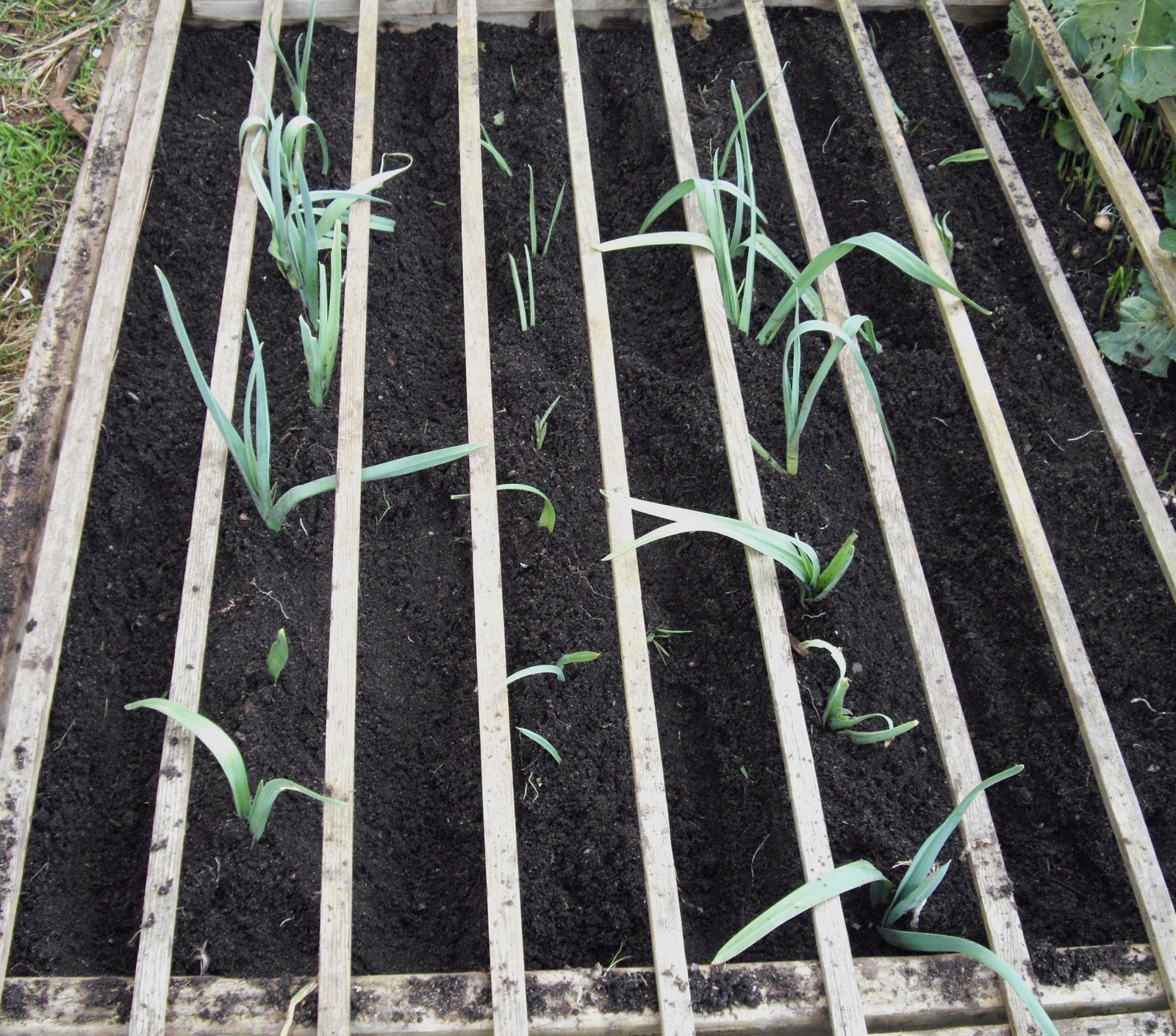
transplanted leeks
Now that the worst of winter has past - one can only hope - it's time to take advantage of the sunshine and get out there to start cleaning out those beds! It's best to do it now for several reasons. First, you won't feel so overwhelmed when all of the chores hit you at once when official planting season begins. Second, you can assess what you have left to harvest and harvest it while jogging your memory of what worked and didn't work. Third, the ground is wet which makes it easier to pull out weeds. Finally, you can take inventory of your seed stash and see what you have and order the cool stuff before it's out of stock. This is the perfect time to get reacquainted with your garden.

Filderkraut cabbage - in at 8.8 lbs
I've spent the last two days bending over and yanking out tons of grass, shot-weed and old vegies out of the blueberry mound in the parking strip and in the raised beds. I harvested another giant Filderkraut cabbage. This baby weighs in at 8.8 pounds of spicy, cabbagey goodness. I'll make a soup then probably try my hands at sauerkraut, which is what this variety is traditionally used for.

Today, I planted French shallots and potato onions. I know, I know, I'm a little late as they should have gone in last fall, so I'll have to see how they do. Since I let some of my leeks go to seed, I now have leeklets coming up. I transplanted those in the same bed with the purple sprouting broccoli. Yep, that's what I said. My purple sprouting broccoli is back! It's shooting up new foliage from the same root systems and old stalks from 2 seasons ago, acting like a perennial. It has survived 6 inches of snow, ice, and below freezing temperatures this year. That stuff is tough! I got a lot of bang for the buck with that one.
 
Purple Sprouting Broccoli is back!
For soil replenishment I'll need to get some compost, corn gluten and mulch. The onions like a layer of mulch and I also want to tamp down the weeds. Corn gluten helps keep the weeds from germinating and adds nitrogen. It's also screaming yellow-orange, so best to mix it into the top layer of soil. I would like to get a load of arborist chips to put down on the parking strip where the blueberries are, but minimum deliveries for the free stuff off of Craig's List is from 6 all the way up to 15 yards! Although I would also use it around the raised bed's pathways, that's a lot of yardage. I would have Mt. Wood Chip in the driveway for awhile. I suppose I could let the neighbors have at it as a sort of mulchapalooza. Hmmmm. This might be the trick to getting Roland to get rid of those dead vehicles in the driveway. He works better with a deadline. I think I'll get on Craig's List and see about getting a load delivered next week.

Sunday, November 6, 2011

Fried Green Tomatoes at the Mog Cottage Cafe

The last of the tomatoes this year
In my estimation, the worse thing about planting tomatoes in the beginning of the season is cleaning them out of the beds at the end of the season. After trying to squeeze the last bit of redness out of this year's crop (as any good gardener in this area would do) the first frost last night prompted me to finally cave and I spent the morning cutting out vines and pulling up stakes. The clamps that were holding the stems up on the stakes were maxed out and difficult to remove. I saved all of the tomatoes worth keeping, red and green, and piled them in a large bucket. Not surprisingly, this load was probably my largest crop. Anyone who's tried to grow tomatoes in this region knows what I'm talking about. The carnage left behind looks rather disheartening though; many of the cherries and red zebras had ripened but split due to all the recent rain. There they lay all over the ground and the bed. Now I'll have to clean them up or I'll have rogue plants coming up next spring. In the mean time, squish, squish, squish getting around the beds.
Purple sprouting broccoli - it's baaaack.

The tomatoes that did the best this year were the red zebras, romas and cherries. The giant yellow brandywine suffered blossom end rot and languished, like giant tepid yellow blobs on the vines. Other self-planted crops came up among the masses including fennel, celery and surprise, surprise, purple sprouting broccoli. In fact it's doing rather well. I was planning to sow in garlic and onion in this bed, but now I have a personal bet as to how long I can keep this broccoli going. Two plants have survived and re-sprouted. The stupid stuff just won't die! I envision purple sprouting broccoli with trunks the size of sequoias in a few years. I guess this is the official brassica bed, crop rotation be damned!

I have several good recipes for fried green tomatoes and it's a darn good thing we both like them. I'm going to Google search for more recipes to use. I'm sure there are plenty and I'm sure a lot of them will be from the Pacific Northwest. If you have any green tomato recipes you'd like to share, pass them along...please!!!


Saturday, April 30, 2011

It's Spring and the Purple Sprouting Broccoli is Back!

As you know, it's been a while since I've posted anything. With horticulture classes starting up again for winter quarter, and the bleak, cold weather to boot, it's been nearly impossible to find the time or get motivated. I've been a total couch potato, stuck to the sofa with the laptop glued to my thighs doing homework or playing computer solitaire. A grim existence. Veg. Gardening has been far from my mind and the garden looks it.

With all of the crappy, cold weather we've had in PNW world this winter, you'd think nothing edible from last season would've survived. I planted the garlic, onions and fava beans last fall, and they have started to show their greens through the straw as expected. But, the Purple Sprouting Broccoli that was so enormous, looked pretty done-in from the big freeze this winter. It was all leaves and no florets last summer and I was hoping it would winter over better than it did. All the leaves drooped and most of the large stalks turned mushy and became these tree-like snags sticking up or flopping over in the bed.

But recently, I've become an optimist (yeah, that's what I said) because when I went to take stalk of the beds to see what prep work needs to be done., low and behold, some of the broccoli has resurrected! Just in time for Easter. A sign from God! OK, maybe not, but I am bursting forth with Purple Sprouting broccoli florets at this very moment. In fact, if one of the plants wasn't flopped over like a ground cover, it could be trained as a standard topiary tree, like what is done to roses. Hmmm, maybe I should try and stake it up. I'll let you know, if I succeed. The others are sending out new shoots all along the barren stems. I should have a bumper crop of PS broccoli this spring. Yay. . . .Crap! There's a white cabbage moth fluttering about.

Thursday, November 4, 2010

The Top 10 Things To Do While Waiting for Purple Sprouting Broccoli to Flower

10. Contemplate tearing it out.
9. Create a Purple Sprouting Advent calendar to count the 240 day period to maturity.
8. Measure the diameter of the trunks (and I mean trunks!) and its height every week.
7. Find the largest leaf and submit it to the
Guinness Book of World Records.
6. Stake it up so it's not flopping over from it's own weight.

5. Find out how many critters are living among it.

4. Fertilize it just for kicks and giggles.

3. Figure out how the heck you're going to pro
tect it from frost and wet, heavy snow.
2. Hold a neighborhood skit for kids on
Jack and Broccoli Stalk...

....And the number one thing to do?

1. Make a list of all the crops you could have planted instead!


Thursday, August 26, 2010

Purple Sprouting Entropy

Entropy: The second law of thermodynamics in that nature tends to take things from order to disorder in isolated systems.

The law of entropy can be applied to the vegetable garden. You see, I had good intentions of planting everything in nice, neat rows all labeled, but alas, entropy took over and as a 'piler' it wholeheartedly sought me out.

Right now, we have Purple Sprouting entropy. As I've stated in a previous post, this particular type of broccoli is meant to be planted in the fall to winter over as it takes 8 months until harvest. We planted ours last April from seed and thinned to around 18" apart. It isn't due to be harvested until this December according to the books. Meanwhile it has grown to gigantic proportions - over 5 1/2 feet tall with the raised bed - while occasionally spitting out flower heads the size of golf balls. And since the weather is getting cooler, it should get really happy and get even bigger; leaves that is. It's taken over almost the entire 4x8 foot bed and shows no sign of stopping. I haven't given it any fertilizer for months. I can't find the labels, but obviously don't need them as you can't mistake what it is.

I think this PS broccoli crop would make great inspiration for a Stephen King horror novel such as, "The Plant: Purple Sprouter" or a campy B grad movie, "Attack of the Killer Broccoli."


I also think that the physicist who came up with the entropy law was a piler.


Thursday, July 8, 2010

Broccoli, Broccoli Everywhere and Not a Flower Head to Eat!

Note to self: Read the packet of seeds carefully and double check another source before planting.

This last Spring, I was going through the packets of seeds at Lowes (I know, I know) and gravitated towards this variety called 'Purple Sprouting' broccoli. I was drawn to the pretty color displayed on the front of the packet and the fact that it was a sprouting variety, not the blobby type heads you see in the grocery store. More like purple rapeseed. So, I grabbed a packet or 2 thinking of wonderful, yummy purple food this summer. I enthusiastically planted a butt load of the seeds in one of the raised beds. It was rather slow to get going, but I chalked that up to the cold Spring we were having.


Well, when I did a plant list for my Spring Culinary Gardening class, I actually read the packet more thoroughly. Good ol' Ed Hume said that this variety takes 120 days to maturity. "Hmmm", I thought, "That takes it into the Fall before I can harvest any of it. Well, I dutifully put the Reemay over the top of the young plants to keep them safe from the white flutter-byes (after picking off a bowl full of little, yellow eggs - so I'm slow to react) and watched them slowly take hold, holes in the leaves and all.

When it finally warmed up, caboom! Now it's July and the stuff is 30" tall, lush with vegetation and no flower heads yet! Not even a hint. Just more leaves coming up the middle. Roland asked, "When are we supposed to harvest this stuff? It's taking up a whole bed!"

I said, "Ed Hume says 120 days. Let me look it up in one of my gardening guides."


240 DAYS?! 8 months! How could ol' Ed have it so wrong? Who the hell plants broccoli (besides, apparently I) that putzes along for 8 months? I guess that's why you plant it for the bleak of winter 'cause nothing much else takes much space other than other cabbages, carrots, garlic, fava beans, lettuce, spinach, beets, etc., etc. I mean, how many crops do you need, really?


So, I brought this up in my summer Culinary Gardening class and teacher Gayle told me, "That's a variety that usually gets planted for overwintering (neener, neener, neener)." And there it was, 'Purple Sprouting' on their PowerPoint list of veg to overwinter in today's class (neener, neener, neener).


I don't mind being the class example, but usually it's for having done something well, so if having broccoli that looks like it's radioactive (sterile), I've certainly done that. I've given up on perfectionism long ago, and now call it 'excelling'. Besides, I figure it's good to be remembered for something extraordinary like successfully over-summering overwintering broccoli.


When we were planting seeds for new starts for the colleges' garden today, teacher Anne relished the idea to give me the packet of Purple Sprouting broccoli (neener, neener, neener). So, for Christmas, I'm sending them each a head of Purple Sprouting broccoli fresh out of my veg garden.