Previous Capers

Monday, March 26, 2012

Ceramic Pots Aren't All They're Cracked Up To Be

It seems like that at the end of every winter I have broken planting containers to deal with. I like natural materials so I like glazed clay. And using glazed clay pots presents some challenges.

It's not that my pots have gotten smucked by extreme temperature swings nor has freezing moisture done its weathering job. It's the cats! At the end of the season, I often place several small pots on the edge of the front porch (which is pretty much anywhere on the porch given that it's only 4 feet deep and there's ten tons of crap on it already) and every year several of our chubby mogs go plowing through the neat lineup on the way to knocking something else over so they can nap on the spot that they shouldn't. Of course, it's always my favorite pots that get broken. You'd think I'd learn by now not to put them where they get bulldozed off the porch or front steps, but being a creature of habit, I inevitably leave them in an area that is convenient for me. Apparently, however, it's inconvenient for the cats. They're creatures of habit too, and like their established paths uninterrupted with things such as expensive ceramic pots.

A slope with newly installed pot fragments.
As one who is resigned to a cracked pot destiny, I have decided to make the most of it by, you guessed it, re-purposing these clay fragments elsewhere in the garden. Yes folks, they get morphed into a design element. I simply bury them in the slope below the bathtubs and plant something in them. It's sort of Mesopotamian looking, after the earthquake or during an anthropological dig.

In addition to looking earthy decorative, these broken pot halves act as small terraces on a relatively unstable hillside. If the sides of the pot pieces don't adequately sweep around, place some decorative rock along where fired clay meets soil to help hold the pots in place and keep the soil from eroding down the hill. The end result makes the whole thing look like you've broken your $30 pots on purpose just for this project.

Of course, it's critical you plant something in these areas right away because chances are you will have fury supervisors watching you build them new places to poop. Cats are good at re-purposing too.

Tuesday, March 20, 2012

The Evil Twin Series: Bored with Your Garden? Try Squirting Cucumbers

It's so much fun to peruse the internet for unusual seed companies. In fact, I came across a great one from, where else, England called Plant World Seeds. Actually, I was entering search ques for old cottage varieties of perennials when I came across this site. I couldn't help myself; I ordered a bunch of seed packets for unusual varieties of different perennials and bulbs. One in particular definitely caught my eye: Ecballium Elaterium or Squirting-Cucumber. Not exactly something you would typically find at your local nursery. Although the fruit is not very edible, it has another endearing value for those of us that posses an evil twin (formerly known as the Jungian id).

According to Plant World Seeds:

Its name alone is a mouthful. And that is precisely what your curious friends will have when they touch the small plum-shaped fruits....Yellow flowers on radiating stems produce intriguing hanging fruits. Unwary inspection triggers the incredible seed distribution method. The swollen fruit breaks off and shoots downwards (remember Newton's Laws of Reaction) propelled by a high speed jet of seeds and water.

Yes folks, it's a cucumber that shoots itself and its seeds across the yard! In fact, according to one source, the record squirt is 45 feet! The fact that the propellant action is triggered by touch has a potential for some wicked fun. The fruits look like the size of kiwis attached to a very Cucurbit-like plant. I plan to place it in a strategic position where curious passer-byes will have a looksie, then ZAP! I just hope that I'm around to witness the fun. There's a couple of neighborhood walkers that I've caught having a peek at my zuccs before.

Of course, I'm assuming that the cats will provide much of the entertainment. The fruits will be just too irresistible looking not to be batted around. If I see a sproinging cat in that vicinity, I'll know what happened. Cheap entertainment for under 3 bucks, eh?

Leave it to the Brits to provide this one. Squirting-Cucumber: It's so Monty Python.

Saturday, March 10, 2012

Floyd Checks Out

Floyd after his recovery
I'm afraid I have some bad news. After several weeks of steady decline, Floyd died peacefully in his sleep last night. Since getting hit by a car in July of 2010, we've kept him going with acupuncture treatments, bladder extractions, many enemas at the vets and lot's of other TLC. Perhaps we should have put him down a long time ago, but he was still Floyd and until recently, actually did have a good quality of life despite the necessary care. He would even pussy foot, head butt and purr at the vet when we brought him into the exam room.

He started to really decline several weeks ago, after his last kitty spa visit. The vet found a lump in his stomach and was planning to monitor it. Floyd would eat like a pig, but became skin and bones. He was also drinking a lot of water. Roland and I think that his weak kidneys caused by previous trouble finally caught up to him.

We'll bury him next to Bonnie in the yard. We'll have to get a rose bush to plant over him, like we did for Bonnie. I'll have to find one with a cultivar name that suits him. I wonder if there's one called 'Problem Child' or 'Lovable Lug'. Perhaps a giant sunflower will grow out of nowhere next to him too.

I'll miss the little delinquent. We're down to 6 cats now and, of course, our dog Snorky. The house is starting to feel empty.

Thursday, March 8, 2012

Yet Another Reason to Drink Wine

Shhhhh, don't tell SDOT!
If you like to have a glass of vino with dinner, like I do, you probably grace your recycling bin with many wine bottles....over time. Instead of tossing them in the bin for the weekly pickup, try re-purposing them for simple garden borders. It's easy-peasy to do and the result can be rather striking. You'll need to buy the varietal of wine that's in a bottle with a distinct neck and shoulder. The sloping shoulders of some bottles (like Chardonnay's) won't stay put as well when you plant them in the soil, nor will you get a straight, solid looking connection between each bottle.


If you wish to calculate how many bottles you'll need for your border, multiply the total running inches and divide by 3 inches which seems to be the average width of a wine bottle. So, for 10 feet, which is 120 inches, divide 120 inches by 3 inches. That equals 40 wine bottles. You'll need more than you think you do.

As you know, wine bottles come in several different colors including blue, dark amber and clear; however, green is the most common. Roland and I end up with a lot of that color because we mainly drink 3 Buck Chuck (in our area it's actually 2.50 Buck Chuck now, but that's too awkward to say). The bottles also come in different heights and some have indented bottoms that will catch rain or irrigation water in the garden. To remove the label, simply soak the bottle in hot water for a while. It should just scrape right off. Apply a little mineral spirits with a rag to remove any stubborn glue residue or just let it slowly wear off in the garden. Some bottle labels are actually etched into the glass, so just consider those bottles part of the charm.

Notice the indented bottom-ups on some bottles.
To install your bottle collection, dig a narrow trench with a garden trowel deep enough so the neck of the bottle will be buried up to the shoulder. The shoulder should be cradled on the soil surface. Unless you find or drink just one brand of wine, chances are the bottles will be different heights so you'll need to adjust the depth of the trench. Make sure the bottles are as plumb as possible and snugged next to each other. You can eyeball weather they're straight and tweak them as you go. Pack the soil firmly around the bottles to hold them in place.

If the bottles are on a slope, you might try a pole stake (like bamboo or a hardwood dowel) to hold the bottle more firmly in place. Measure the stake twice as long as the bottle, then with a rubber mallet, pound just the stake into the hole until enough is sticking up to fit well up just touching the bottom of the bottle (or is it the top now? How 'bout calling it a bottom-up). You'll need to put the stick in the bottle and mark the spot where the stake goes to get the spacing right. If you use rebar, then I suggest you pad it with an electrical tape or a rubber tip of some sort, especially where it may be in contact with the neck of the bottle and around the end of the stake or the bottle could break. This technique may also server you well if you're using bottles for raised bed borders, holding back a lot of soil.

Not only are you re-purposing a common item while adding an attractive element to your garden, the wine bottle border will help warm the soil, encouraging happy plants. Depending on the size of your project, you probably can't drink enough wine to construct your border within your lifetime. If you can, well then.... So, I suggest you become a dumpster diving recycling bin raider to collect enough for your weekend project. Ask your wine drinking cohorts to start saving bottles for you. Just make sure you pick them up in a timely manner, before the beneficiary's garage gets overrun. Be forewarned however; upon hearing about this idea your friends may get inspired enough where they'll be competition with you for a somewhat limited resource. Things could get interesting, like an old Woody Allen movie interesting.
 

Thursday, February 23, 2012

The Adventures of Bunny-Butt Chapter 1: Our Introduction

"MAAAAAAAYMER!" bellows a voice out the front door like a ship's horn. "Kitten, kitten, kitten," the voice continues. Suddenly a bellow from across the street,"MEEEEEEEEEAOUUUUUU, MEEEEEEEEEAOUUUUUU." A small gray, tailless creature streaks across the quiet neighborhood road, up the front steps and through the front door. It's Mamah, who doesn't want to be left out of whatever is going on. She's been across the street, probably schmoozing her favorite neighbors who've named her Squeaky, obviously after her dramatic, high-pitched squeal she's so generous to express.

Just a few weeks old
Mamah (pronounced May-muh, named after Mamah Borthwick, Frank Lloyd Wright's honey. It just seemed to fit.) came into our lives via a neighbor by my place in Arlington. I made the mistake of going to get my mail one day, when out of left field several tiny blobs were thrust in my face.

"Here, take one," the neighbor exclaimed, "they're wrecking my house!"

Upon one look, "Oh, alright," I reluctantly answered, "but I'll only take a female. We have too many male cats that like to mark the house." (Of course, my assumption about female cats would be eventually proven false, as female felines aren't without their complaints. Hell hath no furry like a female cat scorned.)

So, being the sucker that I am, I got the pick from a litter of adorable, evil kittens and selected the only female of the bunch that also happened to be the runt of the litter. All of the tiny fur bundles in this litter were tailless. Mama cat was a tortoise shell and dad happened to be one of several striking Manx I've seen prowling the neighborhood. I wasn't surprised that kittens materialized. People in my neighborhood are all too often adverse or slow to get their animals fixed. So, for what seemed like endless nights of sudden sleep deprivation, I heard multiple coupling events of feline drama under my bedroom window (like an omen). These things always seem to happen under the bedroom window in the middle of the night!

Mamah and Floyd - double trouble
She had to be barely 8 weeks old when I got her, but weaned. I was transporting Floyd back and Forth to my place at the time, so I had to introduce this tiny creature to the trouble maker. Since the early weeks are the impressionable ones for kittens, I definitely set her up to be a problem child with Floyd. Between Floyd's influence and her innate tendencies, Mamah would soon become a handful as she matured from kittendom. Luckily Floyd has a history of treating kittens well, so I wasn't surprised that he took to Mamah right away. He started the habit of licking her butt, as it was an easy target without a tail in the way. When he got tired of her constant attacks, he would move to higher ground, not that she was deterred by it, though.

Mamah also became attached to Vinnie. Every kitten should have an uncle Vinnie. He put up with her endless harassment and being a big, fluffy boy, she would snuggle into his fur for a nap.

Mamah with Uncle Vinnie
Mamah was a super active kitten, always clawing her way up the duvet cover to the top of the bed to play with the bird on a string that I would fling around like I was fly fishing. She would run in circles after it, leaping like a salmon swimming up stream. She had a fascination with kitty litter. I put out a small, shallow box for her tiny body to climb into to do her business, but she would spend large amounts of time simply tossing litter about. She still does at times. The box became a play pen and I went through a lot of vacuum cleaner bags.

In her early weeks, what little tail Mamah had was bent to one side, an indication of cramped quarters among her beefier brothers in the womb. As she matured into a teenager, Mamah's tail evolved into a shape similar to the Pope's nose on a plucked chicken butt; rather tear drop shaped, coming to a defined point like the top of a meringue. We nick-named her chicken butt or turkey butt, but that name eventually evolved like her tail into a more rabbit-like metaphor. Thus, the nickname Bunny-Butt. Being half Manx, her back is shorter than her tailed brethren causing her back end to stick up like a beacon to all of male catdom. She's also a flirt with the boys. We had her fixed as soon as possible, less we end up with 6 more just like her.

Very vocal, she presents a meow that sounds like the damsel in distress on the edge of the building seen in the Edward Gorey introduction to Masterpiece Mystery. And she's very liberal in her vocalizations with a lot of drama in the amplified chortles. She's now one of the gang at Mog Cottage, staying rather runt-like, but her personality more than compensates. Her teenage stage certainly proved eventful.


Tuesday, February 21, 2012

Why Do Gardeners Have Cats? It's That Nurturing Thing

To we gardeners, cats can be the bane of our existence. I can't tell you how many times I have gone out to weed only to find the occasional gooey lump of cat poo buried in the soil. Every time I weed a patch of soil and admire it's lovely soilness, the cats line up like kids at Disney Land just waiting to spoil the soil. They, in their feline hegemony, believe that you're cleaning out the soil for them; like your future cabbage patch is some giant outdoor cat box.

Of course, this issue around garden indiscretions is self-inflicted having adopted 9 of the little darlings (or rather having 9 adopt us as most materialized due to evil human kitten bearers thrust them in our faces proclaiming that they would rather have our house wrecked than theirs). It's the same mentality as a friend of mine having a cat live among the thousands of skeins of yarn in her yarn store. I just chalk it all up to being a certain personality type that gravitates towards a certain lifestyle that tends to incorporate potentially incompatible elements into the mix. For gardeners, it's often animals that use the great outdoors, preferably the unprotected garden spaces, to do their business. We're suckers for a cute face. It's that nurturing thing coming out.

I have listened to a many a gardener protest to me that the neighbor's cat chooses their yard above all others. It may be that their yard hasn't been claimed by a feline resident already, so it's open season for territory. It could be that all that lovely exposed soil, especially out of season is just too tempting for any feline to resist, especially after it's been cultivated to a lovely, fluffy consistency with fresh compost. Let's face it, well kept gardens are cat magnets. We're out there with the pooper scooper but, unfortunately, cats hide it all. Best to be proactive, I think.

Well, I've seen a variety of creative solutions to keep cats out of the beds. One solution is the motion sensor sprinkler head. It's automatic squirt bottle. When the cat gets too close it gets hosed. It sounds like a great solution until you forget to turn it off before working in that area. Plus, I would think you need a whole irrigation system installed for this purpose if your garden is big enough. Maybe just a heat seeking sprinkler head will do. Another solution is laying chicken wire just under the top layer of soil. Awkward! Need I say more? A thirds solution involves sticking a lot of small stakes into the soil. I suppose you could use garden art stakes if you don't like that rustic look, but you need a lot of them close together to discourage the potty behavior. Creativity can be expensive.

Having to deal with cats around our garden, we've come up with a great solution, at least for the veg. beds. Roland built a wooden grid system for each raised bed and the claw foot tubs. The slats are on 4 inch centers, attached to a frame that fits over the bed. Not only does it discourage cats, the grids act as row guides. Each 8 foot long bed has 3 removable sections. The only draw back is the inability to easily remove them if you have large crops such as cabbages, growing through the slats. Other than that, this system is almost 100% cat proof.
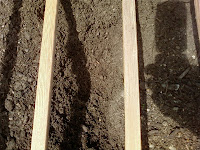
An attempt at breaching the defenses
That being said, sometimes our cats try to use the grids as perches. They precariously squat with one back foot on each slat. Every once in a while I see evidence of attempts like canals dug out or broken slats from our blobs trying it out. Cats like challenges, especially when they know that they're not supposed to do something. They're cunning and when your back is turned.....

As for the open garden spaces for larger crop plants, we most often use the stake method until the vegetation is well establish. By mid summer, our garden is pretty packed with plants, at which time our cats move on to the neighbor's yard.


Saturday, February 18, 2012

Finally, A Veg Book That Has Everything!

OK, I'll admit it. I'm a bookaholic. My shopping list on Amazon is 5 pages long. It's so easy to do that one-click shopping thing! I've collected quite a pile of garden books from the convenience of my computer. Sometimes though, I am incredibly underwhelmed when the book arrives and it doesn't meet my expectations even though I've read the customer reviews that have mostly been favorable. Now I only hit the "buy" button if the book has the "see inside" function. That function has saved me from selecting something that will ultimately be a waste of money.

Every once in a while I find a real gem of a garden book that will end up with bent corners and dirt stains on the pages. My latest find is the newly published book, "What's Wrong With My Vegetable Garden? 100% Organic Solutions for All Your Vegetables from Artichokes to Zucchini" (why publishers have to have such long tag lines in titles is a mystery to me), co-written by Botanist David Deardorff and Garden Coach, Kathryn Wadsworth (Timber Press). This book is so well organized and cross-referenced that it requires only 249 pages, and that includes the index. It's a terse and pithy veg database in a paperback form.

The book starts out with how it is organized (like you can't figure that out yourself with this one) and the best way to use it.The introduction also contains information on recognizing cultural problems in the garden such as adverse water, soil, light and temperature conditions and how to best avoid issues from the get go. Further divided into three main sections, the first section addresses many of the common vegetable species planted in the garden. These pages are outlined in green so you know where this section starts and ends. The next section divides common plant problems by crop family. The final section guides the reader as to what general  proactive organic solutions work for common problems like wildlife helping themselves to your crops, row covers and blasting bugs with the hose.

What sets this book apart is the cross-referencing within each section. You never have to hunt for the information. Simply look up the veg you're interested in, read the general information required to grow it and, if you need help diagnosing a problem, there's a page number located under the title that directs you to that information. When you get to that page, there's a chart on symptoms, diagnosis and solutions. In addition, the solution column further directs you to detailed information.

This book was definitely written by filers (they do have their uses). The information is concisely laid out in colorful charts and even though the photos are small, they are very clear. This book offers nearly infallible means of diagnosing and treating plant problems. If you could only buy one veg garden book, then this is the one you should get. I think that the many other veg books sitting on my shelf will start gathering dust now that I've discovered this great reference.