Previous Capers

Friday, February 3, 2012

Carrots Have A Circadian Clock?

Wow, another thing to keep track of and stash in our gardening repertoire. In the Feb/March addition of Organic Gardening magazine, Michele Owens writes an interesting article on the internal clocks of veg. The premise is if our turnips or radishes aren't mature before they bolt it could be because they weren't planted at the right time of the year and consequently, the length of light they need at certain growth stages is off kilter. According to biologist Takato Imaizumi of the University of Washington who is interviewed in this article, a plant's cells have an internal clock that rhythmically produces proteins that degrade and activate genes again in 24 hours. So, what I gather is that carrots and peas have regular internal sleep/wake cycles. If planted at the wrong time, they get jet lagged.

Now, I know what some of you are thinking in between fits of laughter- "What?!" Yep, your crop failures may not be from planting seeds before the soil temperature is warm enough for germination and the seeds rot.Your bolting lettuce may have hypertension issues from too much sun light, not too much heat. This theory may have some merit though. Imaizumi divides veg into 3 different categories: long-day flowering plants, short-day flowering plants, and day-neutral plants.

Long-day plants include carrot, cilantro, lettuce, peas, radish, spinach and turnip just to list a few. In other words, these veges need longer periods of light to flower. If you live in an area that often has cold springs, like the Pacific NW, long day veg planted in the spring languish until the weather gets warmer. Warmer soil also happens to coincide with more light. Many of these root crops are biennials that need a prolonged cold snap that triggers flowering in summer the following year. This mechanism is supposed to keep them from flowering the first summer, long enough to grow a good edible bit to harvest. Our prolonged cold spring may fool them and thus, when the days get long, they bolt. The plant germinates then shoots for the flowering stage because its internal clock says that's what it's supposed to do.The result is you get underdeveloped plants that flower before they're ready to harvest. The cure? Plant the seeds after the solstice for a fall crop. They develop well because they wouldn't flower until the following summer.

You may be surprised, but tomatoes can get too much light. They're short-day flowering plants. Ever notice that many of your tomato plants finally flower in the late summer to fall when the temperature starts to drop down too much to ripen the fruit? Indeterminate tomatoes just grow and grow and grow foliage until they bust out of their supports, then flower away in mid to late August. The sunlight promotes the vegetation, but the length of light promotes the flowering. This revelation may be why we need a greenhouse to really grow good tomatoes. They need the warmth, but not the light for the fruit to mature. In fact, many of the short-day crops grow better in warmer climates such as, pineapple, black-eyed peas, okra, pomegranate, sweet potato and as mentioned, tomato. Night and day are more evenly distributed all year compared to us, but the temperature doesn't drop to low to croak them before harvest time. Blueberries, June-bearing strawberries, common beans, cucumbers and raspberries grow here, but are either hardier or are at the mercy of our climatic swings.

Day neutral plants include alpine and everbearing strawberries, apple, many of the brassica crops, peach, pear, rhubarb and some cultivars of beans, cucumbers and corn, to name a few. These plants either like it hot or cooler.

Some crops are even sensitive to where they originated latitude-wise, depending on the variety. They evolved to survive at a certain latitude and therefore, light level. Although obviously not a veg, if you think about it, chickens require 16 hours of light a day to lay eggs, thus the seasonality of there egg laying cycle. Where do chickens come from (and don't say "eggs," duh)? Certain areas of the tropics, close to the equator where days are long enough to produce the 16 hour days without the big seasonal light/dark swings that we experience in the Northwest. I know of one backyard chicken aficionado who turns on the flood lights in his hen house until 2am during the winter months so he gets year-around eggs.

Unfortunately, if your long-day plants experience SAD, supplementing their fertilizer with melatonin won't work. However, the taxonomists are developing varieties that tweak that internal clock so we gardeners can grow things that otherwise would be difficult. Not only are our day lengths a consideration, Western Washingtonians experience prolonged cloud cover that can feel oppressive. That's another dimension to consider. Choosing varieties that are not only climate conditioned to ours, but also come from a similar latitude will help to ensure a successful crop.

Unfortunately, this bit of information is just one more thing to keep track of in the art of veg gardening. I could wallpaper my house with all of the charts I'm supposed to keep track of when, what, where and how to plant my veg. In this case, I think I'll start with the Solstice thing and see how it works out.

If you do too, let me know how it works out for you.

Wednesday, February 1, 2012

Spring Cleaning

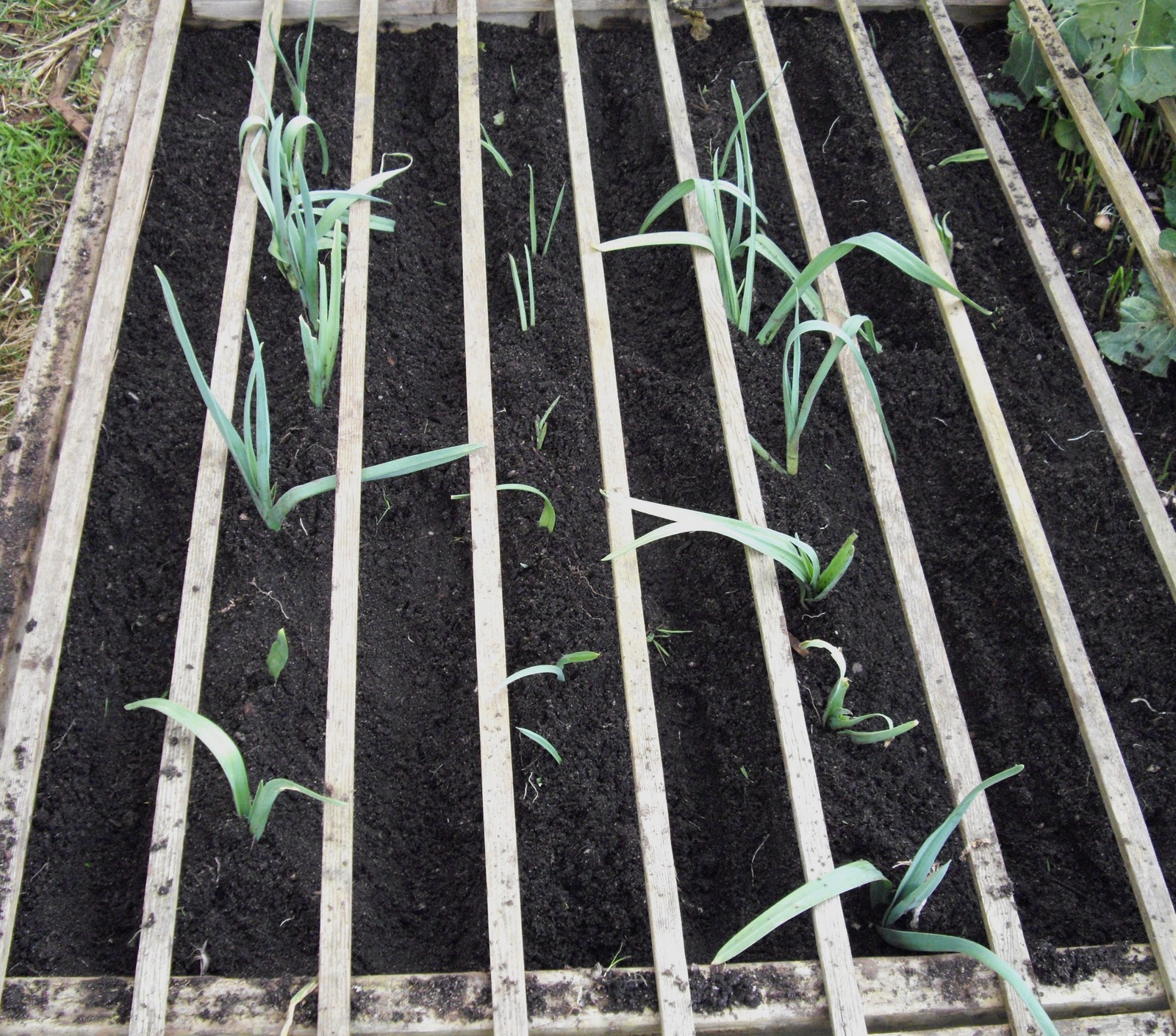
transplanted leeks
Now that the worst of winter has past - one can only hope - it's time to take advantage of the sunshine and get out there to start cleaning out those beds! It's best to do it now for several reasons. First, you won't feel so overwhelmed when all of the chores hit you at once when official planting season begins. Second, you can assess what you have left to harvest and harvest it while jogging your memory of what worked and didn't work. Third, the ground is wet which makes it easier to pull out weeds. Finally, you can take inventory of your seed stash and see what you have and order the cool stuff before it's out of stock. This is the perfect time to get reacquainted with your garden.

Filderkraut cabbage - in at 8.8 lbs
I've spent the last two days bending over and yanking out tons of grass, shot-weed and old vegies out of the blueberry mound in the parking strip and in the raised beds. I harvested another giant Filderkraut cabbage. This baby weighs in at 8.8 pounds of spicy, cabbagey goodness. I'll make a soup then probably try my hands at sauerkraut, which is what this variety is traditionally used for.

Today, I planted French shallots and potato onions. I know, I know, I'm a little late as they should have gone in last fall, so I'll have to see how they do. Since I let some of my leeks go to seed, I now have leeklets coming up. I transplanted those in the same bed with the purple sprouting broccoli. Yep, that's what I said. My purple sprouting broccoli is back! It's shooting up new foliage from the same root systems and old stalks from 2 seasons ago, acting like a perennial. It has survived 6 inches of snow, ice, and below freezing temperatures this year. That stuff is tough! I got a lot of bang for the buck with that one.
 
Purple Sprouting Broccoli is back!
For soil replenishment I'll need to get some compost, corn gluten and mulch. The onions like a layer of mulch and I also want to tamp down the weeds. Corn gluten helps keep the weeds from germinating and adds nitrogen. It's also screaming yellow-orange, so best to mix it into the top layer of soil. I would like to get a load of arborist chips to put down on the parking strip where the blueberries are, but minimum deliveries for the free stuff off of Craig's List is from 6 all the way up to 15 yards! Although I would also use it around the raised bed's pathways, that's a lot of yardage. I would have Mt. Wood Chip in the driveway for awhile. I suppose I could let the neighbors have at it as a sort of mulchapalooza. Hmmmm. This might be the trick to getting Roland to get rid of those dead vehicles in the driveway. He works better with a deadline. I think I'll get on Craig's List and see about getting a load delivered next week.

Sunday, November 6, 2011

Fried Green Tomatoes at the Mog Cottage Cafe

The last of the tomatoes this year
In my estimation, the worse thing about planting tomatoes in the beginning of the season is cleaning them out of the beds at the end of the season. After trying to squeeze the last bit of redness out of this year's crop (as any good gardener in this area would do) the first frost last night prompted me to finally cave and I spent the morning cutting out vines and pulling up stakes. The clamps that were holding the stems up on the stakes were maxed out and difficult to remove. I saved all of the tomatoes worth keeping, red and green, and piled them in a large bucket. Not surprisingly, this load was probably my largest crop. Anyone who's tried to grow tomatoes in this region knows what I'm talking about. The carnage left behind looks rather disheartening though; many of the cherries and red zebras had ripened but split due to all the recent rain. There they lay all over the ground and the bed. Now I'll have to clean them up or I'll have rogue plants coming up next spring. In the mean time, squish, squish, squish getting around the beds.
Purple sprouting broccoli - it's baaaack.

The tomatoes that did the best this year were the red zebras, romas and cherries. The giant yellow brandywine suffered blossom end rot and languished, like giant tepid yellow blobs on the vines. Other self-planted crops came up among the masses including fennel, celery and surprise, surprise, purple sprouting broccoli. In fact it's doing rather well. I was planning to sow in garlic and onion in this bed, but now I have a personal bet as to how long I can keep this broccoli going. Two plants have survived and re-sprouted. The stupid stuff just won't die! I envision purple sprouting broccoli with trunks the size of sequoias in a few years. I guess this is the official brassica bed, crop rotation be damned!

I have several good recipes for fried green tomatoes and it's a darn good thing we both like them. I'm going to Google search for more recipes to use. I'm sure there are plenty and I'm sure a lot of them will be from the Pacific Northwest. If you have any green tomato recipes you'd like to share, pass them along...please!!!


Wednesday, November 2, 2011

The Halloween Hangover


Blueberry bed turned graveyard.
Halloween at Mog Cottage is always exciting. We decked the place out, converting our planting beds into makeshift graves with all the Styrofoam molded headstones, bones and ghouls we could manage to scrounge up at the Dollar Store and the Used Food Store (What Roland calls the Grocery Outlet). During Halloween night, we place lighted candles under each head stone and up the front steps to light the way. 

Enough trick-or-treaters flooded our doorway to scarf up most of the candy, but not before we managed to OD on the stuff ourselves. Although Roland and I are pretty fussy about our chosen sugar delivery systems, the problem is we buy what we like and a lot of it, in anticipation of the costumed hoards of rug rats. On top of that, we buy it well in advance of the day it goes out the door because we want to make sure that what we want will be on the store shelves. When it comes to certain candy, neither of us has a bit of will power. Deep down, we probably don't care. It's only once a year, right?

So, Roland and I scarf on sugar for a good week prior to Halloween,spend another week finishing off the leftovers, then another few days in withdrawal. Even our dog joins in, sneaking tootsie pops out of the bowl when we're not looking. We find sticky, artificially flavored corn syrup balls behind the sofa cushions among the stashed chewies. Yesterday, Roland discovered one of the confectioners thoroughly stuck to the side of our cat, Vinnie. He's now missing a sizable clump of fur trying to dislodge the thing.

Now, I could attribute the theory that these fall/winter holidays are timed right to a candy industry conspiracy when carbohydrate cravings in many of us escalate. These companies know that seasonal darkness and it's ensuing depressive state drives people to pump up the dopamine levels among their grey cells. What easier way to do that than with a culturally accepted legal drug of choice: sugar. So the Halloween holiday often becomes fast, cheap and out of control. In fact, I consider Halloween a kick-off to the confectioners binge that continues until after Easter. People don't need candy much after that because the sun is back and people see the light. The next food binge after October 31st, of course, is Turkey Day. At least we have 3 weeks to come down from this holiday before the food fest.

Front porch - pretty scary
In the meantime, it may take that long to take down all the decorations. Hmmmm. The hanging artificial spider webbing strung across the front porch rather suites the place, don't you think?


Saturday, October 29, 2011

17 Pounds of Potatoes in a 50 Gallon Tub

This year I planted the potatoes a little differently than I did last year. They went into the claw foot tub as usual, but instead of just poking them down a few inches I dug out 2/3rd's of the soil and then planted the potatoes. I stored the excess soil in garbage cans to use later. When the potatoes sprouted their foliage several leaf layers above the soil, I added more soil up to just below the top leaves. When they grew more, I added more soil until they reached the top of the tub. I would then usually mulch with straw, but the foliage was so dense I couldn't adequately add it, so skipped that part this year. When the foliage died back I harvested.

I got quite a few potatoes this year, more red than whites. The main problem I'm facing when harvesting is damaging the potatoes with my shovel. Some of them got sliced in the process. When I use a fork, they got skewered. I attribute this problem to having to dig in close quarters. Of course, I also had some escapees in the process (pictured above). However, I received some great advice from a gardening cohort on how to grow potatoes when you don't have huge amounts of plantable area in the ground. Garbage cans. What a great solution; potatoes grown in a vertical garden!

Next year I'm procuring a classic style garbage can for each variety of potato I plan to plant. I'm using galvanized cans, not those flimsy plastic things made out of petroleum products. Some folk use old tires. Although it is seemingly a good way to re-purpose some of the zillions of old tires that pollute our environment, the thought of planting something I'm going to eat in a petroleum product that God knows has what nasty chemicals leaking out, doesn't sound that organically appealing.

To plant the cans, it's important to have good drainage. I'll be drilling 3-4 drain holes in the bottom of each can and then elevating them on some bricks. I'll start with a foot of soil on the bottom of each can and then plant the potatoes. As with the tubs, I'll add soil as the potatoes grow taller. You'll need to fill a couple of extra cans with soil to use later or have a tarp covered pile stashed somewhere. When the potatoes are ready to harvest, I'll simply push the cans over to spill onto tarps and pick out the potatoes. Skewering and slicing problem solved. Just you and a friend pick up the soil with the tarp and pore it back into storage.

I'm not using potting soil (way too expensive) but an organic planting mix with plenty of compost to keep it fluffy and to add nutrients. A good organic phosphorus based fertilizer mixed in such as, fish bone meal will help increase the yield.


One last tidbit of advice: urban gardeners, keep your cans well away from the sidewalk so dogs don't get tempted and pedestrians don't toss things into them you wouldn't want to eat. Even with the lids off, one never knows, as the cans will be fairly empty looking for awhile.

Come next spring's planting season, I'll let you know how this technique is working.

Saturday, October 22, 2011

Garden Coaching: The Hybridization of Filers and Pilers

Since I've gotten into the horticulture game, I've been made aware of a fairly recent phenomenon; garden coaching. Now, the imagery that comes to mind are pot-bellied plant geeks with clip boards hovering over the gardener yelling encouragement over how to plant zinnias. Cheerleaders with giant dahlia-like pom-poms are doing their cheerleader thing on the sidelines. In reality, garden coaches are rather an outdoor version of indoor organization coaches; helping gardeners clear the clutter of their beds and come up with creative ways to use what they've got to work with. People pay big bucks for the advice.

Last year I wrote about the difference between filers and pilers in the garden world (http://mogcottageurbanfarm.blogspot.com/2010/07/crop-rotation-according-to-filers.html). I think a major amount of a garden coach's clientele are pilers. Filers may hire a coach as a desire to balance their lives with some piling attributes such as, lightening up about gardening. Pilers want to incorporate filer attributes such as, incorporating some order into a hodgepodge called a mixed border. The concept of mixed borders must have been invented by pilers.

Pilers often can't make up their minds because they want everything and are subject to impulse buys at the nursery. They just know that they can fit that fancy new cultivar somewhere. It's hard for pilers to edit out plants. They gravitate towards an Italian style that one of my hort. instructor calls "Oneofeachie."

Filers can't make up their minds in fear of making the wrong choices. They're often so worried about making the wrong choices, they often do, at least in their minds. I usually get free plants from filers. I only get free plants from pilers after they've seen a garden coach. I guess that makes me a piler. Guilty as charged.

Sunday, October 16, 2011

Fiddling with Filderkraut

This year I was so intently focused on the fact that our tomatoes actually turned red, I rather neglected other crops in the garden. Almost daily, I zipped by the bed of brassicas as three cabbage plants got bigger and bigger. I had planted a variety of cabbage called Filderkraut last spring. The Territorial Seed package description states:

This arrow-shaped variety was bred for the cold regions of Europe so that self-reliant gardeners could make batches of sauerkraut for winter consumption.


I liked the idea of an "arrow-shaped" cabbage; the ones in the stores are mostly round with the exception of Napa cabbage. We are also rather self-reliant, I guess, even in an urban environment. We're probably more self-defiant than anything. We both have 'Kraut' genes, too. The problem is, neither of us eats that much sauerkraut, even though Roland is Swiss. In fact, he doesn't eat cheese, mustard, vinegar, mayo, or salad dressings either - but that's another post. In spite of these noble brassica's original purpose, I was thinking more along the line of making soups and stews.

By the time my focus shifted (when the weather turned colder - like it ever got hotter much this year), one of the heads was so heavy, it flopped over in the bed.
To harvest the thing, it took some large loppers to cut through the 3" caliper stem. The leaves pretty much shaded out everything within a 5 mile radius and worst of all, this behemoth of a brassica became a snail and slug nursery! I spent the better part of harvesting this thing stripping off the layers of outer cabbagey leaves and disposing of the mollusks that hid deep down in the crevices near the base. After all, Roland doesn't eat escargot either. After that, I managed to wash off any goo residue and stored it in the refrigerator. Mr. Roland stood for a portrait of him and the cabbage for scale.

Growing monster vegetables serendipitously gives you a good excuse to have to clean out the refrigerator. Luckily, the fridge has heavy duty shelves as the thing must have weighed close to 10 pounds.
Cabbages can be as dense as bowling balls.

The cabbage leaves have a rather peppery flavor. Even at this large size, it cooks up tender and goes great in soups and with pot roast. It's comfort food time, so I don't think I'll have much problem using it up, although it's taken us several weeks to eat down just this one cabbage. There are several more just like it still waiting their turn; however, they haven't flopped over yet, so I figure there's time. I wonder if they'll sweeten up like Brussels sprouts do after a frost. Oh, did I mention? Roland won't eat those either.

I may have to try my luck at making sauerkraut.
After all, I seem to have good luck growing brassica crops. I remember Roland telling me that his dad scraped the mold off his batch every couple of days while it was doing it sauerkrautie thing. Luckily, Roland will eat it. Go figure.