Previous Capers

Friday, June 7, 2013

The Mason Bees Are Placed Out....Finally!

What to do with that gable end on the garden shed. That's been our quandary for the last year or so. Finally, the answer came to us in the form of mason bees. One of the few perks of working at a garden center is the occasional free stuff. The supplier of mason bees brought in a bunch of boxes of the bees in for the employees. Never one to pass up the free box, I brought around a dozen or so home. I figured there wouldn't be a whole lot of takers, given that mason bees require special accommodations.

Mason bee houses installed into the garden shed gable. Note the boxes of bees sitting on top. They go out to pollinate and then come back to lay their eggs in the tunnels, sealing off the openings when filled.
So, Roland came up with the idea of incorporating mason bee houses into the gable ends of the shed. There are several good web sites that give information on how to build mason bee housing and about mason bees in general (PDF Here). The key is to get the tunnels right. Roland used a router bit and carved out half circles in a bunch of boards. When two halves are put together, they form a tunnel. Of course, you can purchase pre-made houses of various sorts, but if you have a wood worker in the household....

Mason bees are like flying salmon. You simply place the boxes of eggs next to the houses of tunnels and once they hatch, they fly out, do their thing then come back to the same place to lay the next generation. Each box of bees contained the eggs of 8 females and 4 males. Since we were late getting the boxes out, it didn't take long for them to bust out. It's a temperature thing. Hopefully, the holes will fill. The females control the sex of their prodigy. As in much of the animal world, the males are expendable, so their eggs get laid in the front part of the tunnel, lest they get devoured by another critter that finds them tasty. In the fall, we'll break apart the houses and store the eggs in the refrigerator for the next season. If you don't harvest the eggs, they can get attacked by mites. In early spring, the eggs go back out next to the cleaned (and sanitized!) houses for the next go around. Since the bees are the first pollinators, it's important to get them out when the fruit trees are blooming. They can handle colder weather than other bees, so are out before the other bees appear.

Mason bees aren't aggressive, so are easy to work with. In fact, it's just a matter of letting them do their thing. With the proper habitat and happy bees, it's possible to get enough bees over time to share with others. With colony collapse disorder destroying bee populations, mason bee populations need to be encouraged.

Now to finish that green roof!

Thursday, June 6, 2013

Reviewing the Seasonality of Vegetables: Consider Lifestyle

Now that I've been cultivating veg going into the 4th year, I've been determined to better fine tune when I plant certain crops. Not that couldn't plant these crops at other times, but I've decided that there are certain times that suite my life better. As much that seasonality is about crop cycles, it's also about lifestyle. And if the plant has a flexibility, it's good to grow it to best suite how you use it. Given the limited space here at Mog Cottage, in some instances I would rather use the space for more seasonally sensitive crops. Seasonality is also about when pests peak too.

Those telltale holes mean cabbage moths have been at it.
Take kale. Every year I plant kale in the spring only to fight with those pesky cabbage moths ((Mamestra brassicae)) putting up an elaborate hoop house with Reemay to hermetically seal off the kale from the world. All this to keep a leaf eating larvae off my kale leaves. This year may be particularly bad given the warm winter we had. I was given 3 broccoli starts this spring. Since I'm not eating the leaves, I just covered them long enough to produce enough leaves where moth damage won't be so disconcerting.

Last year, I didn't get kale planted until August. Actually, I have been known to let kale go to seed and it comes up on its own quite well, even in late fall! At this point, the moths were pretty much gone while the kale started to grow (draping a bit of Reemay over the bed long enough to establish the plants). Kale over-winters nicely here and I like to use kale mainly in the fall and winter months in soups and stews. It also takes up a lot of space. So, the kale can grow and hog the beds when other crops won't grow because it's too cold. It slows down when the weather gets frosty, but perks right back up when the temperature returns to the mid 40's. In mid-spring, it goes to seed, so it gets yanked. I have enough kale seed to last longer than the seed will be viable.

With that, my winter beds consist mainly of garlic, onions, fava beans and kale. Occasionally, I'll plant other cabbage crops such as Filderkraut and, yes, purple sprouting broccoli is on the list. I recently purchased a new packet of the Ed Hume PSB seeds that famously exploded and lasted three years until an infestation of aphids took it out.

So, for summer, I'm planting a great substitute for kale: Swiss chard. It's a great leafy green from the beet family and can be used in most any recipe as a substitute for kale. It takes up less space, leaving room for summer crops. In fact, Swiss chard has a higher nutrient density than kale containing copious amounts of Magnesium, Phosphorus, Potassium, Copper, Beta carotene, Isoleucine and Phenylalanie. Swiss chard is a biennial that pretty much over-winters too, but tends to look rather ragged with time, so I pull it out when it's time to plant the kale.

Although chard supposedly attracts moths too, I've experienced only one issue with Swiss Chard: mollusks. I end up mulching with Slug-go and spent coffee grounds as no amount of Reemay keeps those buggers out. Here, in the great Pacific North-wet, slugs and snail season is 12 months. In the gardening world, it's always something.


Friday, May 24, 2013

Growing Potatoes in a Can

I love getting tips from other gardeners, especially when they work brilliantly. Last year, I received a tip about the best way to grow potatoes. Tired of skewering and slicing my potatoes while digging them out, this year I've planted them in a can: a garbage can that is.

I ventured forth to the big box store and purchased a galvanized garbage can with lid. I had Roland punch 5 drainage holes in the bottom. The bottom happens to be recessed up into the can (like the round ice cream containers) which makes drainage work well. I put about 12 inches of potting soil with some bone meal in the bottom. I then placed my seed potatoes down on top of the soil, distributing them around 4 inches apart. Since the bottom of the can is narrower, you can't place too many at first. I then covered the seed potatoes with more potting soil, around 4 inches deep. I then waited for the first signs of growth.

Now, several weeks later, the potato foliage emerged but it wasn't quite deep enough to add more soil, so I waited and then forgot about them. Several weeks later, KABOOM! With a spell of warm weather, I had potato foliage to the top of the can. I imagine if I had paid attention, I could have witnessed the stuff grow before my very eyes.

So, off I went to the big box store and picked up some more potting soil. 2-1/2 cubic feet later, I had gingerly added more soil to the top leaves of the potato plants. I'll add some more soil when the top grows more, but I can't anticipate them getting much bigger. Deeper soil layers helps keep the potatoes from becoming green, which you want to avoid since that's a sign that the tuber could be producing the nasty, toxic alkaline solanine, as potatoes are in the nightshade family. All parts of a potato plant are toxic except for the tuber.

Potatoes are light feeders, but bone meal helps increase yields. Potato tubers are actually underground stems that store food for the plant. Roots don't have nodes which are called 'eyes' on potatoes. Potato eyes are actually stem nodes. The stems grow out and produce more tubers for more food storage for the plant. Actual roots also come out of the tuber as does the plant the grows towards the sun. The potato plant actually produces seed off its flower, but it takes longer to get it to produce potatoes, thus the preference for 'seed potatoes' which is a form of vegetative reproduction. Growing potatoes vegetatively helps ensure a consistent, true to type crop.

The potato geek taxonomists have divided potato growth into five stages. Stage one involves sprouting and root growth. During stage two, the potato starts forming leaves and branches for photosynthesis. In the third stage, stolons develop out of leaf axils (nodes) on the stems and grow downwards for new tuber development as swellings on the stolon. If the weather gets much hotter than 81 degrees F., tuber formation often halts. The tuber formation bulks up during stage four, when the plant invests a lot of its resources into this process. At this stage it's critical to keep optimal soil temperature, nutrient availability and balance and pests control a top priority. The last stage is maturation where the plant canopy dies back and the skins on the tubers harden. This is when sugars convert to starches.

To harvest, I'll wait until after bloom and when the foliage starts to die back. All I'll have to do is dump the can onto a tarp and pick out the potatoes. I'll put the soil back in the can and put the lid on to store over winter. Next year, I'm getting several more cans so I can produce more varieties. I'll try stretching the soil with compost. Upon harvesting, potatoes need a curing time, but I'll write about that at that time.

Thursday, May 23, 2013

Marcel in Recovery Mode

Marcel assumes his usual position.
Marcel had a followup visit at the vet yesterday. He's doing well and his stitches should come out next week. In the mean time, he taken to being a house cat quite well, although he may be a bit bored.

For Marcel's entertainment, Roland came home with a cat toy the other night. After a healthy competition to play with it, Snorky promptly confiscated the thing and buried it in the sofa cushions (where all his bones reside).

People in the neighborhood who know Marcel belongs to us have asked about him, since he hasn't made his usual schmoozing rounds lately. We haven't seen any missing cat signs go up though.


Sunday, May 19, 2013

Marcel, Our $600 Free Cat

Marcel with stitches and a drain tube in his chin.
Our latest mog, Marcel is becoming another Floyd. Since I brought him home last summer, Marcel has become the neighborhood cat, visiting everyone in a daily routine, even venturing through neighboring cat doors and open windows while working the neighborhood kids for cat treats. He's fearless. Everyone within a 2 block radius knows Marcel. People have offered a trade in exchange for their cat. He just turned 1 year last April. Marcel has been all about adventure from an early age. He's the neighborhood snoop and project supervisor.

When he was 6 months old, the week he was due to go into the vet for shots and to get neutered he went missing. After several days, I put an ad on Craig's List and Roland checked the missing cat list at the local shelter. Low and behold someone 6 blocks away had taken him in to see if he was chipped (not yet) and left their name and number on the register. They also took Marcel back to their home. Apparently, he had wandered off (probably followed someone) and landed in this woman's kitchen with their other tuxedo cat. The day I called, the women had taken him into the vet to get fixed, chipped and shots. She obviously was ready to keep him. Marcel has a way of endearing himself to anyone.

"Oh, well we were going to have that done," I declared merely, just happy to have him found. "So I'd be happy to reimburse you for it. What's the total going to be?" (Thinking around $200)

"$394," she replied.

Swallow. Hard. "Oh, I see."

"We took him to a vet who's the mother of my daughter's best friend," She continued. "I hope you don't mind."

I called Cat's Expensive and paid the bill. I suppose my choices were to pitch a fit and not reimburse her, probably having to give up the cat or collect him with bad energy about the whole thing, or offer half declaring that she jumped the gun and that my vet would have only charged that much, but I decided to just pay it and move on. The woman is keeping our phone number just in case. Several weeks later, I took Marcel to the same vet for a follow up visit for booster shots and another $40 bucks, just to keep the chashectomy services consistent.

He developed a habit of sleeping on top of cars. Fast forward, several evenings ago, Roland got into his van to run to the store. He didn't see Marcel on the roof among all the lumber stacked up. So, off they go up the street with a neighbor running behind trying to flag Roland down to no avail. Roland didn't find out about it until he got back. At some point, Marcel must have jumped because he came running back and hid in his favorite bushes. A neighbor girl saw him and told me that he had a bloody chin. The neighbor across the street also helped look for him and Roland was able to finally coax him out of some shrubberies. Indeed, he had a lovely cut in his chin. The interior of his mouth had some blood in it too. No broken teeth though. He must have taken a leap when the van was in motion and the momentum cause a face plant.

So, the next morning off he goes to our vet, Dr. Zile at Greenwood Animal Hospital. An overnight stay, x-rays and 5 stitches later, he's now a house cat for the time being. He lays around on his back and takes his medicine well. No broken bones. Plus, this episode only costs us around $200 dollars with deferred payment. Dr. Zile knows that we're good customers.

"Just pay us when you get paid," exclaimed Dr. Zile. "I know you always pay us."

I love that vet!
Saturday, April 20, 2013

Lasagna Mulching the 'Lawn'

An old tax assessor's image of Mog Cottage. 
I've never understood the obsession with the perfect lawn. I hate lawn. Yes, it has its places as landscape wall-to-wall carpet (in parks) or area rugs between ornamental borders, but I personally don't care for it on a number of levels. First, lawn is high maintenance. You have to mow and edge and feed the stuff copious amounts of fertilizer and water if you want it to look like anything year 'round. This fact brings up my second complaint: copious amounts of fertilizer and water required for it to look like anything adds to run-off that pollutes streams and ultimately, major water ways like Puget Sound. Ever look at ponds around a golf coarse? On hot summer days they become bubbling caldrons of excess fertilizer that promotes algae blooms.Yuck.

My third complaint is that most folk don't realize that lawn is comprised of plants. In our region, usually fescues and oat grasses. Yes, the grass you mow down to within inches of its life is comprised of a complex plant root system that prefers specific conditions like full sun. Even the so called shade tolerant grasses. Most lawns are forced to thrive on 4 inches of builder's top soil (brought in after they've scraped off all the native top soil to sell off) when the grass would prefer at least a foot of organically rich soil. So most lawns in developments look like crap without the constant chemical applications and huge amounts of water that run off into our waterways. What's worse, in this PNW climate of conifers and glacial till, the soil is full of clay, very acidic and lawns are often forced to grow in shade. This misallocation of grass seed is a grand recipe for moss that thrives on moist, shady acidic conditions. Grass prefers sweeter soil. So what do homeowners do? They resort to copious amounts of lime and Moss-out. Ultimately, a losing proposition except for the chemical companies that make billions on the whole scheme.

Talk about the poster child for male insecurities. I can't think of another marketing scheme that feeds on male insecurity (other than the physical stuff, but that's not for this blog) as much as promoting the perfect grass. It's a direct hit on male burb status. For the most part, it seems like a male obsession. Perhaps it's the women who send them out to conquer the grass in order to get them outside and out of their way on the weekends. I had an uncle who told me that mowing the grass was the only exercise he got. Sadly, he passed away at age 58 (or was it 59).

There's a cat in there somewhere.
And grass can look like hell, if left unkempt. Being a nonconformist entity, Roland is one of the few men I know who doesn't care if the grass grows tall and seeds everywhere. He considers it a cover crop - to cover the cats.

I say, take the stupid lawn out! We don't live in manor houses in England (where this whole thing started eons ago) and the stuff's a pain in the patootie. There are far better uses for that spot of ground, like growing food. If you want a green patch, there are a number of ground-covers that look lovely as replacements and add interesting texture. You can put a stone or gravel path where you need to tromp around.


An organic way to remove lawn is to layer cardboard or copious amounts of newspaper and woody mulch. Commonly referred to as sheet mulching, I prefer the term lasagna mulching since my yard is primarily planted with edibles. First, cut the grass as short as possible. Apply several layers of cardboard down (you can get refrigerator crates from appliance stores) and then at least 3-4 inches of woody mulch. I use arborist chips. Wet down or do it when it is going to rain. And don't pick a windy day. Now this process takes some time - around a six months to a year to thoroughly settle in. I finally finished the front area and will not be planting or doing anything except maintaining the escapee's around the edges (but that didn't stop me from buying plants, of course). I'll probably apply salt or vinegar to problem areas. The cardboard and chips will compost in, attract worms and feed the soil. The decomposing grass goes along for the ride.

Epimedium 'Fire Dragon'
I purchased a gallon container of the ground cover Epimedium 'Fire Dragon' for under the Camellia. It takes dry shade, will colonize the area and blooms lovely little bell-shaped yellow and pink flowers. I'll just have to keep it alive until it can be planted. I didn't do a good job taking care that the grass stay shorn last year, so now I have to contend with digging out what seeded into the planting beds (and containers. Argh!). It will be an on-going chore as grass has a habit of coming back if all of the roots aren't completely removed.

Grass is taking over the beds!
Grass belongs in, well, grasslands.

Tuesday, April 2, 2013

The American Cranberry Bush

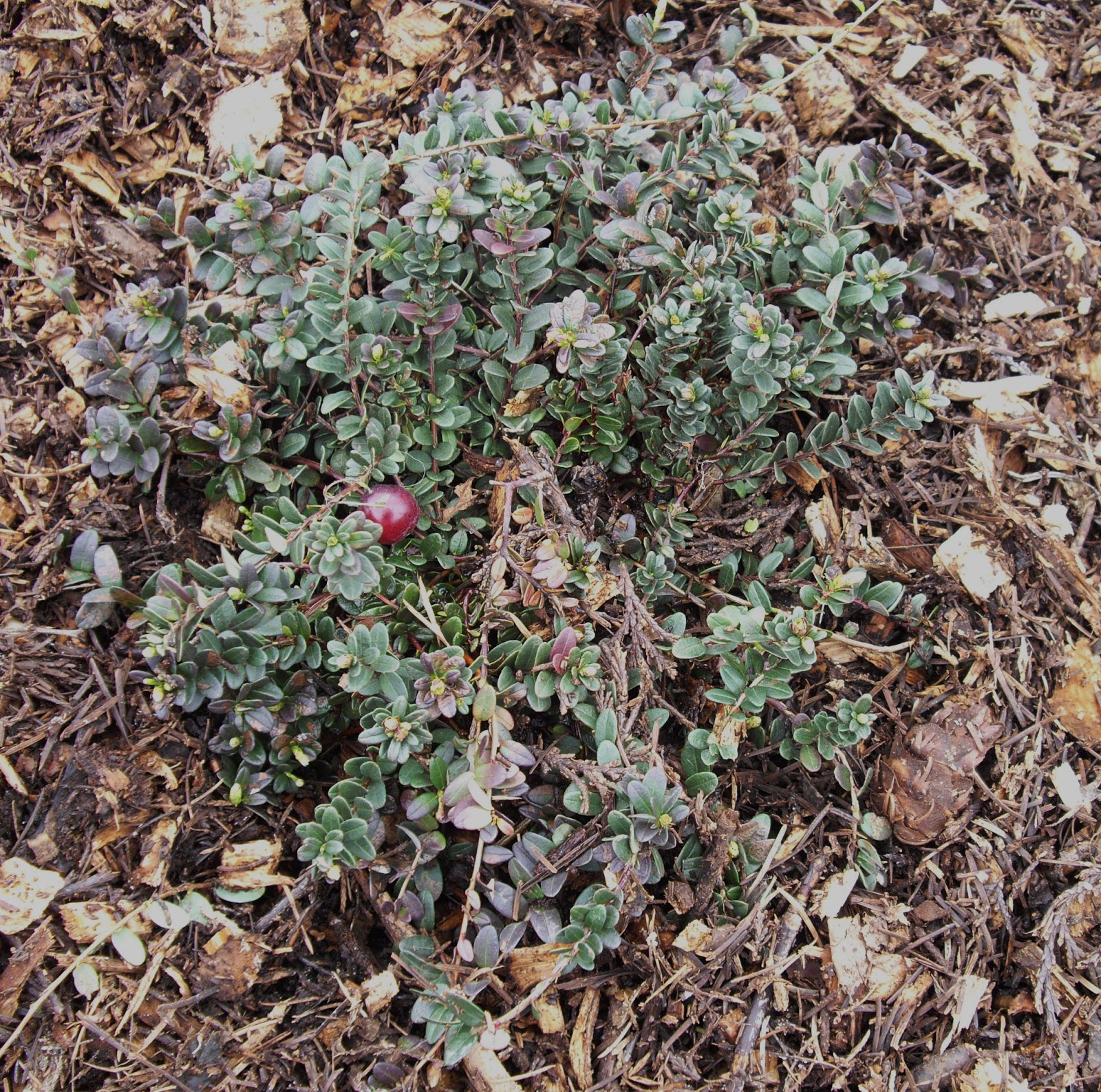
Vaccinium m. 'Lo Hugger' with a single hanger-on
Several years ago, I planted our parking strip with blueberry bushes on a small, bermed area that runs up part of the length. Since then, I've been trying to figure out what would make a good edible plant along the slope (besides the ever opportunistic violas that have volunteered their services there). Having planted several berry producing groundcovers such as Rubus pentalobus, nothing has really taken to that area. I then came across an American cranberry bush cultivar called 'Lo Hugger' at work and finally had that woohoo moment.

Not having an over abundance of space, this little gem only get 4-6" tall and is somewhat spreading. Pink flowers give way to large red berries (you can see one still hanging on in the picture) that last into winter. It's hardy down to zone 4. The grower, Fisher Farms states on their web sit that this plant is deciduous while at the same time stating that the leaves turns red in the winter. We shall see.

Like their taller cousins the blueberry bush, Vaccinium macrocarpon generally likes full sun and moist soils, although they can take part shade and seasonal flooded conditions. In fact, harvesting is often done by flooding the cranberry fields with 6-8 inches of water above the bushes and corralling up the floating berries into a corner. They are then pumped up from the beds into trucks that take them to the sorting stations. As flooding the parking strip is not an option, I will be picking them by hand. Perhaps this variety would be a good candidate for the bottom of a rain garden. A good layer of arborist chips around the shrubs should help keep the moisture in.


I nestled 3 plants among the blueberry bushes and hope to harvest enough cranberries for cranberry sauce during the holidays. That is if the opportunistic crows or Stubby doesn't get to them first.